If you develop a fever while traveling in Korea, you can easily access safe and effective over-the-counter (OTC) medications at local pharmacies.
This guide focuses on evidence-based fever reducers, especially acetaminophen (paracetamol) and ibuprofen, which are the global standard treatments.
What is Fever and When Should You Treat It?
Fever is generally defined as a body temperature above 38°C (100.4°F).
It is a natural immune response, but treatment is recommended when:
- You feel uncomfortable (headache, chills, muscle pain)
- Temperature exceeds 38.5°C
First-Line Fever Medicines in Korea
Acetaminophen (Paracetamol)
✔ What it does
- Reduces fever (antipyretic)
- Relieves mild to moderate pain
✔ How it works
Acts on the central nervous system, inhibiting prostaglandin synthesis in the brain.
→ This lowers the body’s temperature set point.
✔ Common brands in Korea

- Tylenol (타이레놀) – most famous
- Various generic acetaminophen products
✔ Typical adult dose
- 500–650 mg every 4–6 hours as needed
- Maximum: usually 4,000 mg/day
✔ Advantages
- Safe for most people
- Preferred for:
- Pregnant women (with medical advice)
- Patients with stomach issues
⚠ Precautions
- Liver toxicity risk if overdosed
- Avoid combining with alcohol
Ibuprofen (NSAID)
✔ What it does
- Reduces fever
- Stronger anti-inflammatory effect than acetaminophen
- Relieves pain (headache, muscle pain, sore throat)
✔ How it works
Blocks cyclooxygenase (COX) enzymes → reduces prostaglandins
→ lowers inflammation and fever
✔ Common brands in Korea

- Advil (애드빌)
- Brufen (부루펜)
- Many generics
✔ Typical adult dose
- 200–400 mg every 3-4 times a day
✔ Advantages
- More effective when fever is accompanied by:
- inflammation
⚠ Precautions
- May cause:
- stomach irritation
- gastrointestinal bleeding (rare but serious)
- Avoid if:
- history of ulcers
- kidney disease
- late pregnancy
Which One Should You Choose?
| Situation | Recommended |
|---|---|
| general use | Acetaminophen |
| Fever + inflammation | Ibuprofen |
| Sensitive stomach | Acetaminophen |
👉 Both are effective. Choice depends on your condition and medical history.
Can You Combine Them?
- In some cases, alternating acetaminophen and ibuprofen is used
- However, this should be done carefully to avoid overdose
👉 If unsure, consult a pharmacist
Combination Cold Medicines in Korea
Many Korean OTC cold medicines include acetaminophen as a fever reducer along with:
- Antihistamines (runny nose)
- Cough suppressants
- Decongestants
Examples:
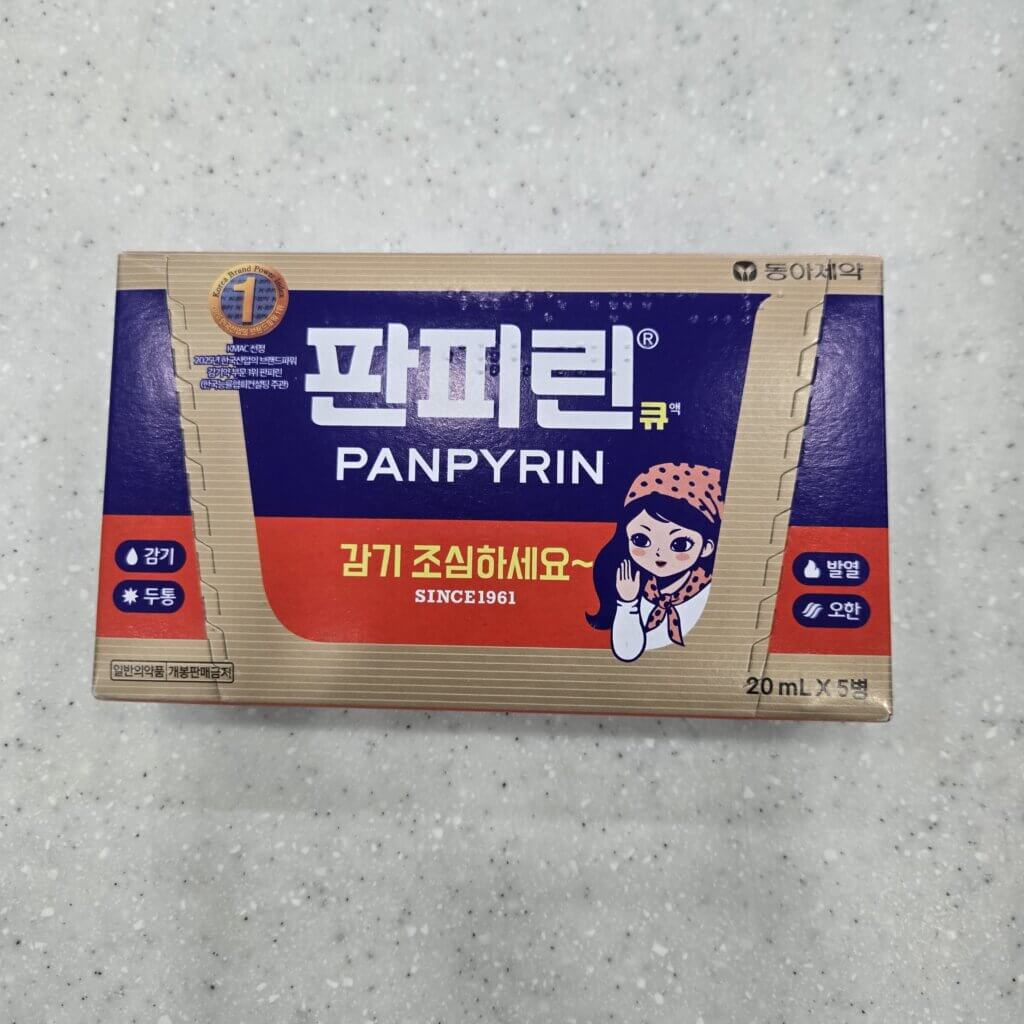
- Panpyrin-Q (판피린-Q)
- Theraflu Nighttime (테라플루)
- Coldaewon Cold Q (콜대원콜드큐)
- Whituben Q (화이투벤)
- Champ Cold Syrup (어린이용)
⚠ Important:
- Do NOT combine these with additional acetaminophen
- Risk of unintentional overdose
Where to Buy in Korea
- Available at pharmacies (약국, Yak-guk)
- No prescription needed
- Pharmacists are highly accessible and helpful
Useful Phrases in Korea
- I have a fever → 열이 납니다(
yeoli-nayo) - I need fever medicine → 해열제가 필요합니다(
haeyeoljega-pil-yohabnida) - I have body aches → 몸살이 있습니다(
momsal-i iss-eoyo)
When to See a Doctor
Seek medical care if:
- Fever > 39°C
- Lasts more than 2 days
- Accompanied by:
- severe headache
- rash
- difficulty breathing
- persistent vomiting
Conclusion (Evidence-Based)
Acetaminophen and ibuprofen are both clinically validated, first-line treatments for fever.
- Acetaminophen is safer for general use and sensitive patients.
- Ibuprofen provides stronger anti-inflammatory effects.
The choice should be based on:
- Symptom profile (pain, inflammation)
- Patient condition (stomach, liver, kidney)
- Safety considerations (dose, combinations)
👉 In Korea, both are easily accessible, affordable, and pharmacist-guided, making fever management straightforward for travelers.
Over the counter Cough medicine in korea
Hospital for foreigners : Korea medical tourism guide